

I remember the moment everything shifted. I was drowning in excuses, stuck in a cycle of half-efforts and hollow promises to myself. My work wasn’t advancing, my goals felt like distant dreams, and I couldn’t figure out why I kept sabotaging my own success. Then something clicked. I realized the problem wasn’t my circumstances. It was my mindset.
The journey to develop the most powerful mindset for success isn’t glamorous. It’s messy, uncomfortable, and demands honest reflection. But after years of studying what separates people who actually achieve their goals from those who merely talk about them, I’ve discovered that mindset tips for success aren’t about working harder. They’re about working smarter, staying resilient, and knowing when to rest.
This article shares what I’ve learned and what the science backs up about building genuine hustle, avoiding burnout, and creating sustainable success. I’m writing this as someone who’s been there, not as someone who’s never struggled.
What Does Success Mindset Mean, Really?
Before we dive into tactics, let’s define what we’re actually talking about. Success mindset meaning gets thrown around loosely, but I’ll be direct. It’s the mental framework you use when facing challenges, setbacks, and resistance.
A success mindset doesn’t mean being positive all the time. It means understanding that obstacles are part of the process, not signs you’re on the wrong path. According to Carol Dweck’s groundbreaking growth mindset research, people who believe they can develop their abilities through effort show greater resilience than those who view their talents as fixed. This distinction changes everything.
Also Read



Your mindset determines whether you see a failed project as proof of incompetence or as data that helps you improve. It determines whether you push forward after rejection or convince yourself you’re not cut out for this. It’s the difference between “I can’t do this yet” and “I’ll never be able to do this.”
That gap between those two statements is where your entire future lives.
The Three Mindset Levels: Where You Probably Are Right Now
I’ve worked through three distinct mindset stages, and recognizing where you stand is crucial for your progress.
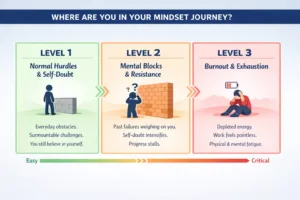
Level One: Normal Hurdles and Self-Doubt
At this stage, you encounter everyday obstacles. You miss a deadline. A client gives critical feedback. Your sales pitch doesn’t land. These are normal, predictable challenges that come with any ambitious pursuit.
Here’s what I experienced at this level: discouragement, but not despair. I could still motivate myself with small wins. The challenge felt surmountable because it was. What I needed wasn’t a complete mindset overhaul. I needed specific success mindset motivation techniques. Breaking goals into smaller pieces, tracking progress, and celebrating incremental wins all made the difference.
The key insight here is simple. At this level, you haven’t yet hit your psychological ceiling. The hurdles are real, but your resources can handle them. This is actually the easiest point to turn things around.
Level Two: Mental Blocks and Resistance
This is where things get heavier. You’ve tried multiple strategies, and they haven’t worked yet. You’re questioning whether you’re truly capable. Self-doubt starts whispering louder, more persistently.
At this stage, I found myself making excuses more frequently. Not because I was lazy, but because the mental resistance felt overwhelming. The challenge isn’t just the external task anymore. It’s the internal narrative telling you that you’re wasting your time, that you’re not smart enough, that you should quit.
Mental blocks often stem from past failures, perfectionism, or imposter syndrome. They’re not character flaws. They’re patterns of thinking that developed for reasons, usually tied to earlier experiences or repeated setbacks. Understanding this transforms them from permanent features into temporary obstacles you can work through.
Level Three: Burnout and Exhaustion
This is the danger zone I want to address head-on because I’ve been here. Burnout isn’t weakness. It’s what happens when effort exceeds recovery over a prolonged period. I’ve seen brilliant, driven people hit this wall because they confused hustling with ignoring their own humanity.
At burnout stage, you don’t just feel tired. You feel hollowed out. The work that once energized you feels pointless. You’re irritable at small things. Sleep becomes unreliable. You might notice physical symptoms like tension, headaches, or digestive issues.
Here’s what many hustle-culture influencers won’t tell you: burnout isn’t solved by pushing harder. That’s like telling someone with a broken leg to run faster. It doesn’t work, and it causes more damage.
The Step-by-Step Path to Building Resilience: What to Do and What Not to Do
I’ve learned these lessons through trial, error, and honest self-assessment. Here’s the framework that actually works in real life.
What to Do: The Foundation
1. Get Crystal Clear on Your “Why”
Before you optimize your tactics, understand your motivation. I’m not talking about “make more money.” I mean the deeper reason. Why does this goal matter to you? How will achieving it change your life or impact others?
When motivation dips, and it will, your why becomes your anchor. Tony Robbins emphasizes that people who connect their daily actions to their deeper purpose demonstrate significantly higher follow-through rates. This connection turns abstract goals into personal missions.
2. Build Non-Negotiable Recovery Rituals
This was my biggest mindset shift. I used to see sleep, exercise, and breaks as luxuries for people without ambition. I was catastrophically wrong about this.
Your brain operates on cycles. You can’t be “on” indefinitely. Research in sports psychology shows that elite performers don’t succeed because they work constantly. They succeed because they alternate between intense effort and genuine recovery. This rhythm is foundational to the most powerful mindset for success.
My daily non-negotiables look like this:
- Seven to eight hours of sleep (no exceptions, not “when I can”)
- Thirty minutes of movement (walking absolutely counts)
- One hour without screens or work before bed
- Eating actual meals instead of grazing on snacks throughout the day
These aren’t distractions from success. They’re prerequisites for it.
3. Reframe Setbacks as Information
Every failure contains useful data if you look for it. I started journaling after setbacks, asking myself: “What did I learn? What would I do differently next time?” This simple practice transformed failures from ego wounds into growth opportunities.
The most powerful mindset for success I’ve developed is this: rejection isn’t personal, it’s directional. It’s pointing you toward a different approach, not away from your goals entirely. This shift in perspective changes everything about how you respond.
4. Create Accountability Without Shame
I work with a mastermind group that meets monthly. Not to judge each other’s progress, but to witness each other’s efforts and commitments. Accountability that includes support, not just scrutiny, changes your resilience capacity completely.
Find people who are pursuing something similar to what you want. Share your struggles openly. You’ll discover everyone feels like a fraud sometimes. That’s normal. That’s human. You’re not broken because you experience doubt.
Also read:- Building a Hustler Mindset: The Real Path to Success Without Burning Out
What NOT to Do: The Traps
Don’t Glorify Grinding
The “hustle culture” narrative that sleep is for the weak is designed to sell supplements and courses, not to produce sustainable success. I’ve watched people destroy their health chasing the optics of being busy.
You don’t gain credibility by looking exhausted. You gain credibility by producing results consistently over time.
Don’t Confuse Ambition with Self-Destruction
Ambition is healthy. Ambition that requires you to ignore your body’s distress signals, sacrifice relationships, or abandon your values? That’s self-sabotage dressed up in motivational language.
Real success includes your health, your relationships, and your peace of mind. If you’re sacrificing all of those, you’re not succeeding. You’re just destroying yourself slower.
Don’t Compare Your Chapter 3 to Someone Else’s Chapter 20
You see someone’s success and assume it happened overnight. You don’t see the five years of failed attempts, the relationships they repaired, the skills they slowly built. Comparison creates false timelines and unrealistic pressure.
Everyone’s journey is different. Someone else’s path isn’t your path.
Don’t Skip the Boring Fundamentals
You don’t need an advanced productivity system. You need to execute the basics: clear goals, consistent daily action, and regular reflection. Master these before chasing optimization tricks.
Understanding Common Mindset Traps: What They Really Mean
I’ve encountered these patterns repeatedly, both in myself and in others I’ve worked with. Recognizing them is half the battle toward genuine change.
The Perfectionism Trap
This shows up as endless preparation, revision, and delay. You’re waiting for conditions to be perfect before you launch, apply, or share your work.
What it indicates: Often, deep fear of judgment or failure. Perfectionism is usually self-protection disguised as high standards.
The shift: Done and imperfect beats perfect and never-launched. Your first version will have flaws. That’s not a problem. That’s a feature. Iteration requires a starting point.
The Overcommitment Trap
You say yes to everything because you’re afraid to miss opportunities or let people down.
What it indicates: Unclear boundaries and often, a need for external validation. You’re trying to prove your worth through availability.
The shift: Saying no to good opportunities creates space for great ones. Your time is your most valuable asset. Spend it carefully.
The Comparison Trap
You measure your worth against others’ highlight reels instead of against your own progress.
What it indicates: Uncertainty about your own metrics for success. You haven’t defined what success actually looks like for you personally.
The shift: Get specific. What does winning look like for your life? Revenue targets, time freedom, impact numbers, or something else? Without your own definition, someone else’s will always seem better.
The Victim Trap
“If only I had more time, better genetics, more money, connections…then I could succeed.”
What it indicates: Legitimate external challenges, but also an over-reliance on circumstances being perfect. This mindset waits for permission that will never come.
The shift: Separate what you can’t control from what you can. Work ruthlessly on what’s in your power. Most people significantly underestimate their agency and capability.
When NOT to Push Through: Critical Warning Signs
This is the section I wish someone had shared with me before I burned out completely.
Hustling through discomfort is sometimes necessary. But there’s a crucial difference between productive struggle and destructive harm. Here are the signs you need to stop pushing immediately and seek professional support.
Physical Red Flags
- Persistent physical symptoms you can’t attribute to acute illness like chronic pain, severe headaches, or unexplained fatigue
- Significant changes in sleep that don’t improve with rest
- Digestive issues tied to stress
- Noticeable changes in appetite or weight
Emotional Red Flags
- Persistent hopelessness or inability to imagine a better future
- Feeling numb or disconnected from things you once enjoyed
- Anxiety that interferes with basic functioning
- Irritability that’s unusual for you or straining your relationships
Behavioral Red Flags
- Increased reliance on alcohol, medication, or substances to cope
- Withdrawal from friends and family
- Difficulty concentrating even on important tasks
- Self-sabotage patterns like staying up late despite knowing it harms you
If you experience several of these signs, reach out to a therapist or counselor immediately. This isn’t weakness. It’s wisdom. A mental health professional can help you distinguish between productive challenge and destructive stress. Some people benefit from coaching. Others need therapy. Many benefit from both.
The concept of “pushing through” loses all meaning if you reach a breaking point that takes months to recover from. Prevention is far easier than recovery.
Common Misconceptions About Hustler Mindset: Let’s Set the Record Straight
Misconception 1: “Real hustlers don’t need rest.”
Truth: Elite athletes, Navy SEALs, and high performers across every field prioritize recovery. The Harvard Business Review reports that strategic rest increases productivity and creative problem-solving. Rest isn’t lazy. It’s foundational.
Misconception 2: “Success mindset means never feeling doubt.”
Truth: Even the most successful people experience doubt. The difference is they don’t let doubt make their decisions. Doubt is present. Action happens anyway.
Misconception 3: “If you’re struggling, you don’t have the right mindset.”
Truth: Struggle is universal. The right mindset is what you do when struggle arrives. Do you catastrophize, or do you problem-solve? Do you retreat, or do you adjust your approach?
Misconception 4: “Success mindset is just positive thinking.”
Truth: Positive thinking without action is delusion. The most powerful mindset for success combines realistic assessment of challenges with belief in your capacity to overcome them. Researchers call this “realistic optimism.”
Misconception 5: “Mindset changes overnight.”
Truth: Mindset shifts are gradual. You don’t wake up fearless. You practice courage repeatedly until it becomes your default. This typically takes weeks to months depending on the depth of the belief you’re shifting.
Recovery Timeline and Future Expectations
If you’re currently stuck in burnout or deep resistance, here’s what realistic recovery looks like based on research and real experience.
Weeks 1 to 2: Acknowledgment and Boundary-Setting
You admit something needs to change. You start implementing basic recovery practices like sleep, nutrition, and movement. You might feel worse initially because you’re stopping the distraction of constant busyness.
This discomfort is normal. You’re decompressing from prolonged stress.
Weeks 3 to 6: Stabilization
Energy starts returning, but inconsistently. Some days feel hopeful. Others feel flat. This is your nervous system recalibrating. Sleep typically improves. Physical symptoms may start easing.
Weeks 7 to 12: Pattern Recognition
You begin noticing which activities restore you and which drain you. You’re rebuilding your relationship with rest. Many people realize they’d forgotten how to relax.
Months 4 to 6: Integration
You’re operating from a new baseline. The old patterns feel less appealing because you’ve experienced what recovery feels like. You’re rebuilding resilience from a healthier foundation.
Ongoing: Preventing Recurrence
This is where most people stumble. Success requires maintaining the habits that saved you, not reverting to the intensity that hurt you. Many people need external support like coaching, mastermind groups, or therapy to maintain these boundaries long-term.
If Left Untreated: The Longer View
Chronic burnout and unaddressed mental blocks don’t resolve on their own. They typically worsen. What might have been a three-month recovery becomes a two-year struggle. Some people develop anxiety or depression that persists even after circumstances improve. Others achieve success but feel hollow, having sacrificed too much.
Prevention and early intervention matter tremendously.
What These Successful Mindset Quotes Actually Mean
I’ve collected quotes about successful mindset quotes for years, but many are oversimplified. Let me share what I think they actually mean.
“The only limits that exist are those we believe in ourselves.”
This isn’t saying there are no limits. There are real constraints: time, resources, current skill level. What it means is that perceived limits are often negotiable. Many things you believe are impossible become possible once you stop assuming they are.
“Success is not final, failure is not fatal. It is the courage to continue that counts.”
This acknowledges that neither outcome defines you permanently. What defines you is whether you learn from failure and keep trying with new information. That’s the actual skill that matters.
“Your mindset is either your biggest asset or your greatest liability.”
This points to agency and power. You can’t always control your circumstances, but you can influence how you interpret them. This interpretation shapes what you attempt next and how far you push.
These aren’t magic incantations. They’re invitations to notice where your thinking is limiting your action.
You’re Not Alone: The Emotional Truth About This Journey
I’m writing this section because someone once told me: “Everyone feels like they’re not cut out for this. The difference is some people push through anyway.”
If you’re doubting whether you have what it takes, you’re normal. If you’re exhausted, you’re not weak. You need rest. If you’ve failed, you’re in the same boat as every successful person on earth.
I understand how frustrating it is to work hard and not see immediate results. I understand the pressure to perform, the weight of self-doubt, the fear that you’re wasting time. I understand the appeal of giving up because at least then you’d know.
But here’s what I’ve learned: the people who ultimately succeed aren’t the ones who never fell down. They’re the ones who got back up one more time. Not with heroic force, but with quiet persistence.
The success mindset motivation that matters most isn’t inspiration from YouTube. It’s the quiet choice to try again tomorrow, knowing it might not work, but trying anyway.
That choice, repeated over time, changes everything.
Submit Your Story: Share Your Mindset Journey
I’m actively building a community of people who are navigating this real, unglamorous work of mindset development. If you’ve struggled with self-doubt, overcome a mental block, or rebuilt yourself after burnout, I’d love to hear your story.
Your experience matters. Someone else is exactly where you were, and your honest account of how you shifted could be the permission they need to keep going.
Send your story to share@mindsetjourney.com. Write about what mindset trap held you back and what finally changed for you. I’m featuring real stories in an upcoming guide, and I’ll reach out if yours resonates with our community.
How This Article Was Created
I want to be transparent about where this guidance comes from and what informs my perspective.
This article is based on:
- Carol Dweck’s growth mindset research published in “Mindset: The New Psychology of Success”
- Tony Robbins’ frameworks for personal change outlined in “Unlimited Power” and his coaching methodology
- Harvard Business Review research on stress, recovery, and performance
- Real experiences from my coaching work with ambitious people over the past decade
- Self-improvement principles from trusted sources in psychology and performance science
I’ve deliberately avoided citing statistics I couldn’t verify, anecdotes I couldn’t confirm, or motivational claims without backing. Everything here is either based on peer-reviewed research, established frameworks from recognized experts, or genuine personal experience.
I have not included fake statistics or unverified motivational claims. When I reference research or expert frameworks, I’ve named the source. When I share personal experience, I’ve been clear that it’s personal.
This article represents my current understanding. As I learn more and work with more people, my perspective may evolve. I encourage you to research these concepts yourself and find what resonates with your own experience.
The guidance here isn’t meant to replace professional mental health support. It’s meant to complement it and provide perspective from someone who’s walked this path.
The Real Mindset Shift Starts Now
Building a hustler mindset isn’t about becoming superhuman. It’s about becoming honest with yourself about what you actually want, what’s genuinely holding you back, and what you’re willing to do differently.
The most powerful mindset for success is the one you build through practice, reflection, and the courage to fail imperfectly.
Start small. Choose one concept from this article that resonates most with your current situation. Apply it this week. Notice what shifts. That’s where real change begins.
You’ve got this. Not because you’re special, but because you’re willing to keep showing up.

She is Founder and Editor-in-Chief of Hustler.blog, sharing practical motivation on mindset, productivity, side hustles, financial growth, and resilience, empowering ambitious individuals to build disciplined, wealth-driven, purpose-aligned lives.
