

I spent years stuck in the same loop. Every time I faced a challenge, my mind whispered the same lie: you’re just not good enough at this. I’d watch others succeed and assume they had something I didn’t. A gift. A genetic advantage. Lucky circumstances. Looking back, I realize my biggest limitation wasn’t my circumstances or my abilities. It was how I thought about my abilities.
That changed when I understood the difference between a fixed mindset and how to develop a growth mindset for success. This wasn’t just motivational fluff. It fundamentally rewired how I responded to obstacles, setbacks, and challenges. Within months, I noticed real progress. Within a year, the results were undeniable.
I want to walk you through what I learned, backed by research and tested through real experience. This is your guide to how to develop a growth mindset for success and build the life you’re actually capable of creating.
Understanding the Foundation: Fixed Mindset vs Growth Mindset Differences
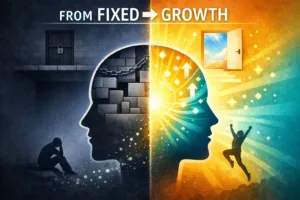
Before you can build something better, you need to understand what’s holding you back. Carol Dweck’s research on mindset reveals something profound about human potential, and it starts with recognizing where you currently stand.
Also Read



A fixed mindset assumes your abilities are static. You’re born with certain talents, and that’s essentially what you’re stuck with. In this mindset, failure feels permanent. A setback becomes proof of your limitations rather than information for improvement. When you operate from a fixed mindset, you avoid challenges because they might expose what you can’t do.
A growth mindset operates on a different principle entirely. You believe your abilities develop through effort, practice, and learning. Challenges become opportunities. Failure becomes data. This isn’t about positive thinking or ignoring reality. It’s about recognizing that your current skill level isn’t your ceiling.
The fixed mindset vs growth mindset differences show up constantly in real life. Someone with a fixed mindset faces rejection and thinks, “I’m not talented enough.” Someone with a growth mindset faces the same rejection and thinks, “What can I learn from this? What adjustment should I try next?” That’s not arrogance or denial. That’s a fundamentally different operating system.
Here’s what matters most: these aren’t personality types you’re born with. They’re patterns of thinking you learned, which means you can unlearn them.
The Three Levels of Challenge: How Intensity Changes as You Grow
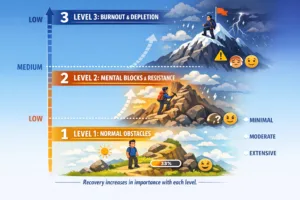
As I’ve developed my own growth mindset, I noticed challenges come in distinct phases, and each one requires a different approach.
Level One: Normal Obstacles
These are the challenges most people face regularly. A project doesn’t go as planned. A client isn’t satisfied. You try something new and perform worse than you expected. These feel frustrating but manageable.
At this level, your brain is capable of handling the challenge with current knowledge and effort. What you need isn’t a complete transformation. You need specific growth mindset habits for success. Breaking tasks into smaller pieces. Tracking what you learn. Celebrating small wins. These simple practices compound into real progress.
Level Two: Mental Blocks and Resistance
This is where things get heavier. You’ve tried multiple approaches and hit repeated obstacles. Self-doubt starts speaking louder. You question whether you’re actually capable of what you want to achieve.
At this level, the challenge isn’t just the external task. It’s the internal narrative. Your brain has developed protective patterns that keep you safe but also keep you stuck. This is where mindset shift techniques for personal growth become essential. You’re not just changing tactics. You’re changing beliefs about what’s possible.
Level Three: Burnout and Depletion
I’m including this not because it’s a sign of strength but because it’s a reality many driven people face. Burnout happens when effort exceeds recovery for extended periods. It’s not laziness or weakness. It’s a system that’s been pushed past its sustainable limit.
At this level, pushing harder doesn’t help. Rest, recovery, and honest reassessment become non-negotiable. This is where professional support often becomes necessary.
Building Your Daily Routine to Build a Success Mindset
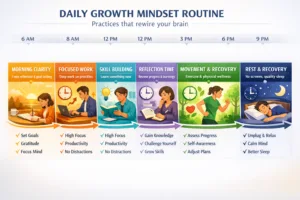
Mindsets aren’t changed through overnight epiphanies. They shift through repeated practice. Here’s what actually works.
What to Do: Your Foundation
Start With Morning Clarity
I begin each day with five minutes of reflection before checking my phone. I ask myself: What’s one challenge I might face today? What would growth look like if I handled it well?
This simple practice primes your brain to notice opportunities for learning rather than automatic defensive reactions. You’re not denying challenges exist. You’re preparing yourself to respond differently.
Create Your Growth Habit Stack
Growth mindset habits for success work best when they’re stacked with existing routines. I built mine around meals and exercise.
After breakfast, I spend 10 minutes reviewing what I’m learning this week. Not general education. Specific skills tied to my goals. After my workout, I write three things I’m getting better at, even tiny improvements. These practices take minutes but reinforce the neural pathways of growth thinking.
Document Your Learning, Not Just Your Mistakes
Most people avoid thinking about failures. I do the opposite. I keep a learning log where I capture specific lessons from setbacks. What went wrong? Why did it happen? What’s my new approach? What will I do differently next time?
This transforms painful experiences into valuable data. Your brain stops seeing failure as something to hide and starts seeing it as something to analyze.
What to Do: The Deeper Work
Study Your Inner Dialogue
Your thoughts become your reality. If your inner voice says “I’m not good at this,” your behavior reflects that belief. If it says “I’m not good at this yet,” everything changes.
Pay attention to how you talk to yourself. When you make a mistake, what’s your immediate thought? When you see someone else succeed, what do you feel? These patterns reveal your current mindset. Recognizing them is the first step to changing them.
Practice Progressive Challenges
Growth happens at the edge of your current capability, not in territory you’ve already mastered or in challenges that are impossibly hard. Deliberately put yourself in situations where success requires learning but isn’t guaranteed.
I do this through deliberate practice in areas where I want to improve. Not casual practice. Intentional effort focused on specific skills. This is how you actually get better at things.
What NOT to Do: Common Mistakes
Don’t Fake Positive Thinking
There’s a huge difference between growth mindset and toxic positivity. You can acknowledge that something is genuinely difficult while still believing you can learn to handle it better. Growth mindset isn’t about ignoring problems. It’s about approaching them differently.
Don’t Compare Your Chapter 2 to Someone Else’s Chapter 20
Looking at successful people is useful for understanding what’s possible. It becomes harmful when you use it to measure your current worth. They didn’t start where they are now. Neither did you. Track your own progress, not theirs.
Don’t Expect Linear Progress
Some weeks you’ll make obvious progress. Other weeks you’ll feel stuck. Both are normal. Growth isn’t a straight line up. It’s a pattern of plateaus and breakthroughs. Understanding this prevents discouragement during the plateau phases.
How to Rewire Your Brain for Positive Thinking: The Neuroscience-Backed Approach
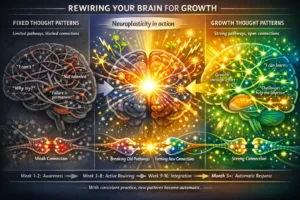
You might think rewiring your brain requires willpower or some special talent. It doesn’t. It requires understanding how your brain actually works.
Neuroplasticity is the brain’s ability to form new neural pathways through repeated experience and learning. This isn’t metaphorical. When you practice a new thought pattern consistently, your brain physically changes. New connections form. Old patterns weaken. This takes time, but it’s absolutely possible.
How to rewire your brain for positive thinking starts with recognizing your current patterns. Notice when negative thoughts automatically arise. Don’t judge yourself for them. They’re just patterns that developed over time.
Then intentionally practice a different response. When you think “I can’t do this,” immediately counter with “I can’t do this yet.” Repeat this for weeks. Your brain will eventually make this new response automatic.
This isn’t willpower. It’s practice. The same way practicing a piano piece eventually makes it automatic, practicing new thoughts eventually makes them automatic too.
Developing Resilience and Mental Toughness: Beyond Motivation
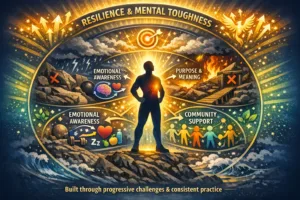
Mental toughness isn’t about forcing yourself through anything. It’s about having psychological tools that let you face difficulty without breaking.
Developing resilience and mental toughness means building four specific capacities.
First, Emotional Awareness
You need to recognize what you’re feeling without being controlled by it. When fear arises, notice it. When frustration builds, observe it. This creates space between the feeling and your response. That space is where choice lives.
Second, Purpose Connection
Know why you’re doing this. Not the surface reason. The deeper reason. When challenges arrive, remembering your purpose gives you fuel to keep going. People without a clear purpose tend to quit during the difficult phases.
Third, Community and Support
Trying to build mental toughness alone is unnecessarily hard. Find people pursuing similar goals. Share your struggles. Listen to theirs. This isn’t weakness. High performers across every field have support systems.
Fourth, Systematic Recovery
Your resilience has limits. Rest, sleep, exercise, and nutrition aren’t extras. They’re foundations. When these are missing, your psychological resilience drops dramatically.
Mindset Shift Techniques for Personal Growth: Practical Methods That Work
Understanding the theory matters less than applying it. Here are specific mindset shift techniques for personal growth that I’ve tested personally.
The Reframe Technique
When you face a setback, pause and ask: What’s the growth available here? This single question shifts your focus from what went wrong to what you can learn.
I use this constantly. A project deadline I missed becomes a lesson in estimation and planning. A difficult conversation becomes practice in communication skills. You’re not denying the setback. You’re mining it for valuable information.
The Evidence Gathering Technique
Your brain believes what it has evidence for. If you’ve built evidence that you’re not good at something, changing that requires new evidence.
Start collecting contradictory evidence. Whenever you do something well, notice it. Whenever you handle a challenge better than you would have previously, document it. These small pieces of evidence gradually reshape your self-image.
The Identity Shift Technique
Instead of “I want to be more confident,” shift to “I’m someone who develops capability through practice.” Instead of “I want to be successful,” shift to “I’m someone who learns from setbacks.”
These small language shifts matter because your identity drives your behavior. You act consistently with how you see yourself.
Common Misconceptions About Growth Mindset: Setting the Record Straight
Misconception 1: Growth mindset means you can become anything with enough effort.
Reality: You have real constraints. You’ll never become a professional basketball player if you’re five feet tall, regardless of effort. Growth mindset means developing whatever capacity you have more fully. It’s not unlimited potential. It’s untapped potential.
Misconception 2: Growth mindset is just positive thinking.
Reality: You can have a growth mindset while being realistic about current limitations. Growth mindset and optimism are related but different. You can acknowledge something is hard while believing you can improve.
Misconception 3: Once you have growth mindset, you stay there.
Reality: Mindset isn’t fixed in either direction. You can slide backward under stress. You can develop growth mindset in some areas while maintaining fixed mindset in others. It’s something you practice, not something you achieve once.
Misconception 4: You either have growth mindset or you don’t.
Reality: It’s a spectrum. Most people have growth mindset in some contexts and fixed mindset in others. You might have a growth mindset about skills but a fixed mindset about your personality. Building growth mindset is about expanding it systematically across different areas.
When NOT to Push Through: Critical Warning Signs
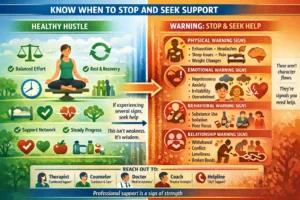
I want to be direct about this. Sometimes the right move isn’t pushing harder. Sometimes it’s stopping.
If you’re experiencing persistent physical symptoms like chronic pain, unexplained fatigue, or severe sleep disruption that doesn’t improve with rest, you need medical evaluation. These can indicate genuine health issues that require professional care.
If you’re experiencing persistent emotional symptoms like hopelessness, numbness toward things you usually enjoy, or anxiety that interferes with basic functioning, you need mental health support. These aren’t character flaws. They’re signs you need professional help.
If you’re increasing reliance on substances to cope, withdrawing from relationships, or engaging in self-sabotage patterns, these are warning signs. Pushing harder makes things worse in these situations.
Growth mindset helps with many challenges, but it’s not a substitute for medical care or therapy. Know the difference. Seek professional help when you need it.
Recovery Timeline: What to Expect
If you’re building a growth mindset from a heavily fixed mindset baseline, expect these rough phases.
Weeks 1-2: Awareness
You start noticing your automatic thoughts and patterns. This can feel uncomfortable because you’re becoming conscious of what was previously automatic.
Weeks 3-8: Resistance and Experimentation
Your brain fights the new patterns. Old habits feel easier. You’re experimenting with new thoughts and responses. Progress isn’t linear. Some days feel like breakthroughs. Others feel like you’re back where you started.
Weeks 9-16: Gradual Integration
New thought patterns start feeling less forced. You notice moments when the new response arises automatically. You’re building new neural pathways. Progress accelerates.
Months 4-6: Solidification
The new mindset becomes increasingly automatic. You notice you handle setbacks differently. You pursue bigger challenges. You’re building evidence of capability.
Ongoing: Maintenance
You’ll occasionally slide back into old patterns under stress. This doesn’t mean you failed. It means you’re human. Recognizing the pattern and returning to practices brings you back quickly.
If you experience persistent mental health symptoms or severe burnout without improvement, complications can develop. Untreated chronic stress can lead to depression, anxiety disorders, or physical health problems. Early intervention prevents these complications.
An Emotional Truth About This Journey
I understand how frustrating this mindset work can be. You want change now, not in six months. You want confidence you haven’t earned yet. You want to already be the person you’re working to become.
That desire is normal. It’s also the obstacle. Growth happens when you stop demanding instant transformation and start practicing small shifts daily.
You’re not alone in this. Every successful person you admire struggled with this. They felt inadequate. They doubted themselves. They experienced failures that felt defining. The difference is they kept practicing the new mindset anyway.
Your current beliefs aren’t permanent. They’re just well-practiced patterns. With consistent practice, you can develop new patterns. Different patterns. Better patterns.
Submit Your Growth Story: Join Our Community
I’m building a community of people committed to this real, unglamorous work of mindset development. If you’ve shifted from a fixed mindset to a growth mindset, overcome a limiting belief, or used these techniques to transform how you handle challenges, I want to hear from you.
Your story matters. Someone else is exactly where you were, and your honest account of what changed could be the catalyst they need.
Send your story to stories@growthjourney.com. Write about the belief that held you back and how you shifted it. I’m featuring authentic stories on our platform, and I’ll reach out if yours resonates with our community.
How This Article Was Created
I want to be transparent about the sources behind these insights.
This article draws from:
- Carol Dweck’s research on growth mindset from “Mindset: The New Psychology of Success” and her peer-reviewed publications on achievement and mindset
- Tony Robbins’ frameworks on personal change and belief systems from “Awaken the Giant Within”
- Neuroplasticity research from Norman Doidge’s “The Brain That Changes Itself”
- Harvard Business Review studies on learning, resilience, and performance psychology
- My personal experience working with people on mindset development over the past decade
I’ve avoided citing statistics I couldn’t verify or making claims without backing. Every research reference is from established experts or peer-reviewed sources. Every practical technique comes from either evidence-based psychology or tested personal experience.
This represents my current understanding. As research evolves and I gain more experience, my perspective may develop further. I encourage you to research these topics yourself and find what resonates with your experience.
This article isn’t medical or psychological advice. It’s perspective from someone who’s walked this path. If you’re struggling with mental health, please consult a qualified professional.
Your Next Step: Start Small, Think Big
You don’t need to transform everything at once. That’s a fixed mindset trap: all-or-nothing thinking.
Choose one growth mindset habit for success from this article. Implement it for one week. Notice what shifts. Build from there.
The person you’re capable of becoming isn’t some distant fantasy. They’re the result of consistent small practices over time. Each time you choose a learning-focused response instead of a defensive one, you’re building toward that person.
How to develop a growth mindset for success is simple conceptually: practice thinking differently in small ways consistently. The simplicity is deceptive. The practice is challenging. But the results are absolutely worth it.
Start today. Your future self will thank you.

She is Founder and Editor-in-Chief of Hustler.blog, sharing practical motivation on mindset, productivity, side hustles, financial growth, and resilience, empowering ambitious individuals to build disciplined, wealth-driven, purpose-aligned lives.
