
I never imagined I’d become obsessed with how children focus until I sat watching my nephew one ordinary afternoon. He was scrolling through three apps simultaneously, his eyes jumping between screens the way a bird hops between branches. His mother, my sister, looked exhausted. “He can’t sit with anything,” she said quietly. I recognized that tone. It’s the voice of someone who thinks they’ve failed at something fundamental.
It took me a while to understand what I was actually witnessing. This wasn’t a broken child. This was a child living in the world we’ve built for him. And watching him struggle with attention made me wonder: when did we stop teaching focus, and why did we assume children would naturally possess it?
The Moment Everything Changed
The real shift came when my sister stopped fighting her son’s nature and started observing it instead. She noticed he could sit for 45 minutes building with Legos. He could listen to one specific podcast episode three times over. His attention wasn’t missing. It was just untrained, the way a muscle that’s never been used stays weak.
This realization landed differently once I started paying attention to what experts actually say about how children’s brains develop. Carol Dweck’s research in Mindset shows something we often overlook: when we label a child as “unable to focus,” we’re not describing a fixed reality. We’re creating one. The language we use becomes the story the child believes about themselves.
What struck me was how recent this problem actually is. Twenty years ago, we weren’t having urgent conversations about childhood attention spans. The difference isn’t that children changed. The difference is that their environment did.
Also Read



How Work and Technology Reshaped Childhood
When I think about the evolution of attention in childhood, it mirrors something larger happening in how we work and live. Just as Dan Pink described the shift toward “Free Agent Nation” in the early 2000s, we’ve witnessed a parallel shift in childhood: the move from sustained, single-focus activities toward continuous partial attention.
Kids now grow up in what you might call a “slash world.” They’re students/social media users/gamers/content consumers all at once, constantly context-switching the way modern workers do. The difference is that adults chose this fragmentation (often reluctantly). Children never had a choice. They were born into it.
The platforms and devices designed to capture our attention are optimized by behavioral scientists. Before a child even gets a phone, they’ve been primed by streaming, by notifications, by the ambient hum of screens in every room. The economy of attention, as it turns out, is built to win.
But here’s where I noticed something important: just as some adults have learned to cultivate multiple meaningful careers rather than one job, some children are learning to cultivate sustained attention as a deliberate practice. It’s not happening by accident. It’s happening by design.
What Actually Changed in My Sister’s Approach
My sister didn’t overhaul her entire parenting strategy. Instead, she made small, deliberate shifts that felt almost mundane in their simplicity.
She created a space. Not a punishment corner or a special “focus room,” but a quiet area with minimal visual noise. A place where the brain could settle because the environment supported settling. This mattered more than she expected.
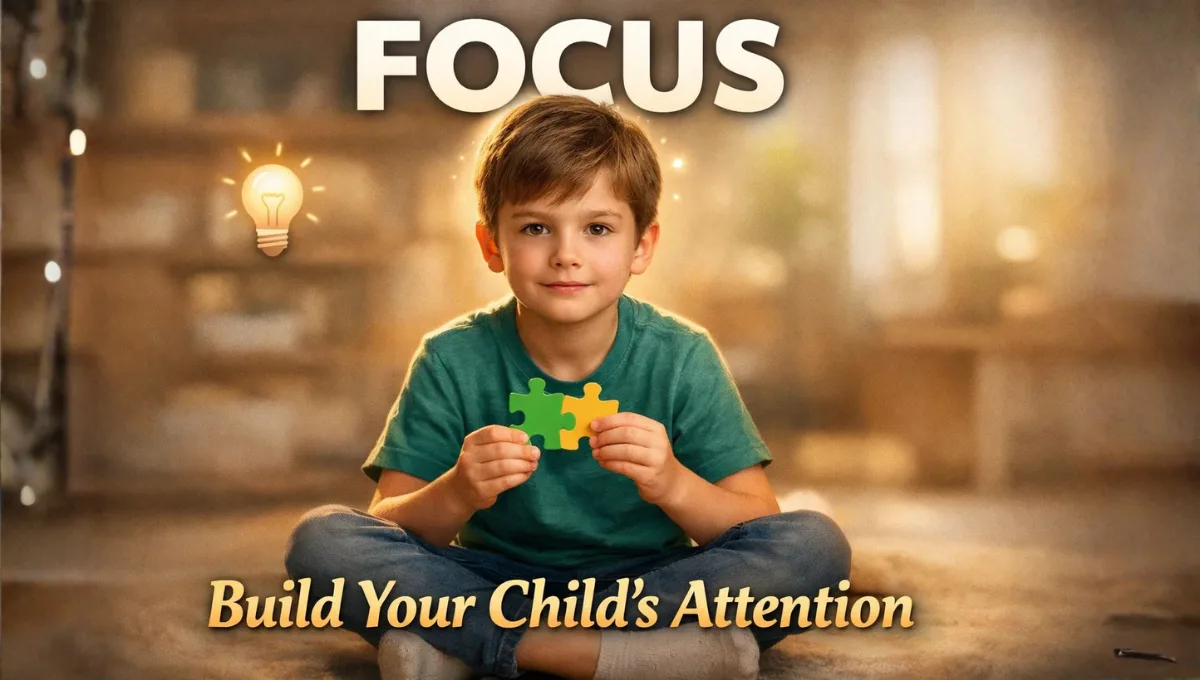
She established a rhythm. Every afternoon at the same time, she and her son would spend fifteen minutes together without screens. Not long enough to feel like a chore. Long enough to matter. They built puzzles. They read slowly, with pauses. They talked about what he noticed. The repetition meant his nervous system began to expect it, to prepare for it.
She talked about his mind like it was something he could shape. Not “You’re so distracted,” but rather, “I noticed your attention stayed with that for twenty minutes today. That’s what happens when you decide to stay.” She was building his awareness of his own capacity, his own agency.
She set boundaries around screens not through shame, but through observation. She noticed that 90 minutes of video before homework made the next hour nearly impossible. But 90 minutes after dinner actually helped him wind down. The boundaries became less about rules and more about patterns she’d noticed.
Also read:- Motivation Meaning With Example: The Night I Learned Motivation Is Not a Feeling
The Quiet Truth About Building Focus
What I came to understand, through watching this unfold over months, is that attention is fundamentally about training, not talent. This isn’t controversial. Neuroscience confirms it. The prefrontal cortex, the part of the brain that handles focus, isn’t fully developed until the mid-twenties. That means struggle with attention isn’t a sign of something wrong. It’s a sign of something still developing.
Angela Duckworth’s research in Grit revealed something consistent across high achievers: they weren’t naturally more focused. They had simply practiced staying with difficulty. They’d built what she calls “grit,” which is partly the ability to maintain attention on something hard when everything in you wants to quit.
I think about Kobe Bryant’s interviews where he talks about training his concentration the same way athletes train their bodies. Day after day. Small repetitions. Until it becomes automatic. He wasn’t born with supernatural focus. He built it.
What’s interesting is how this mirrors the evolution of work itself. People aren’t becoming more naturally suited to slash careers and gig work. They’re learning to build the habits and mindsets that make those careers sustainable. The same is true for children and attention.
What We’re Actually Teaching
Here’s what I noticed about what my sister was really doing, beneath the surface. She wasn’t training her son to be a productive machine. She was teaching him something far more fundamental: the experience of choosing to stay present.
Every time he sat with a puzzle when distraction called, he was practicing a choice. Not because he was forced, but because he’d learned what it felt like to be fully absorbed in something. That felt experience matters more than any lecture about focus.
She was also teaching him that his mind belongs to him. Not to the device. Not to the algorithm. Not to whatever is newest or loudest. In a world engineered to fracture attention, that’s a form of rebellion.
And quietly, without making a big deal of it, she was showing him that small daily choices compound. That consistency matters. That the version of yourself you’re building right now, through tiny repeated decisions, becomes who you are.
Reflections on What’s Changed
I think about how differently childhood attention looks now compared to, say, a decade ago. It’s not that children were naturally more focused then. It’s that the external world made certain kinds of attention easier.
The shift in what captures attention. Kids now compete for focus against systems designed by teams of engineers to be irresistible. That’s not a character flaw in the child. That’s structural.
The language around attention has evolved. We used to talk about “focus” as a moral quality, a sign of discipline. Now we’re beginning to understand it as a skill, something trainable, something that varies depending on context and engagement and environment.
We’re learning to value different kinds of attention. A child’s ability to hyperfocus on Legos for two hours might seem different from sitting with a book, but neurologically, it’s the same capacity. The question is how to help that capacity transfer across different domains.
The role of presence has become clearer. During the pandemic, when many children lost the structure of school and the presence of teachers, attention struggles became more visible. It illuminated something we’d maybe taken for granted: a child’s ability to focus partly depends on feeling that someone present cares whether they do.
What Actually Moves the Needle
If I’m being honest about what I’ve observed working, it’s nothing revolutionary. It’s old.
Start with one small ritual. Not multiple changes. Not a complete overhaul. One thing, done consistently. A walk. A puzzle together. A book read slowly. Something your child naturally gravitates toward. Do it the same time every day for two weeks. Don’t measure progress. Just show up.
Create the conditions. A quiet corner. Fewer visual distractions. A time when screens are simply not an option. You’re not being strict. You’re designing an environment where focus becomes possible because the noise has been reduced.
Help them notice their own patterns. “What helped you stay with that?” “How did your mind feel while you were building?” You’re not coaching. You’re building their awareness of themselves. That awareness becomes the foundation of agency.
Use real consequences, not punishment. If homework takes forever because of scattered energy earlier in the day, that’s the natural feedback. Reality is sufficient. You don’t need to add shame on top of it.
Read together. Not to get through the book. Read a few pages, pause, notice what you both imagined. This trains attention while it trains connection, and honestly, connection might matter more.
The Longer View
What’s interesting to me is how this small domestic project, improving a child’s attention, mirrors something much larger about how we all need to live now. We’re all learning to cultivate focus in an age of fragmentation. We’re all learning to choose what gets our attention in a world designed to steal it.
My nephew, a few months into this quieter approach, still gets distracted. He’s a kid. But something has shifted. He knows what sustained attention feels like now. He’s experienced the satisfaction of completing something he started. He knows he has some say in where his mind goes.
I think about what we’re really building when we help a child develop attention. We’re not creating little robots who sit still. We’re building humans who understand their own minds. Who know they have agency. Who feel what it’s like to choose depth instead of drift.
In a culture that profits from scattered attention, teaching a child to focus is a quiet act of resistance. It’s saying: I believe your mind matters. I believe you can direct it. I believe small daily choices, repeated, become who you are.
There’s a New Yorker cartoon I saw recently, spoofing how everything has become fragmented. It made me laugh. You know an idea has truly sunk in when there’s humor spoofing it. But beneath the joke is something real: we’re all learning how to hold attention in an age that makes it harder. And the children we’re raising? They’re learning alongside us.

She is Founder and Editor-in-Chief of Hustler.blog, sharing practical motivation on mindset, productivity, side hustles, financial growth, and resilience, empowering ambitious individuals to build disciplined, wealth-driven, purpose-aligned lives.
