
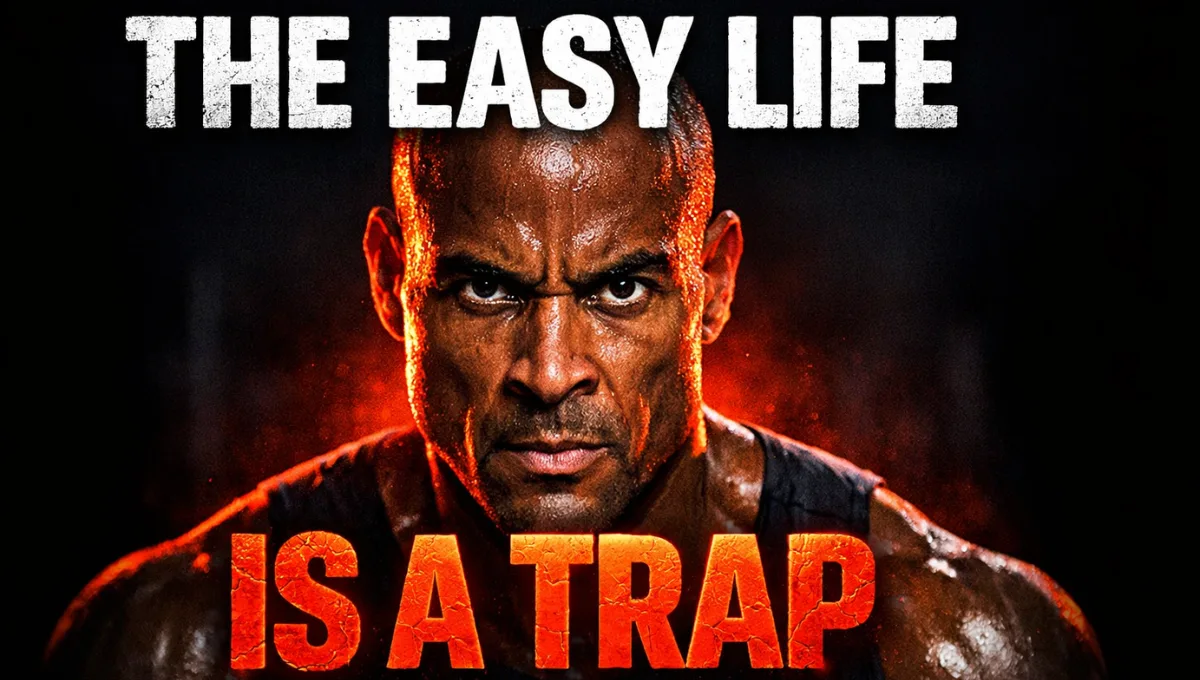
You wake up at 6:47 AM. Nine minutes before your alarm. You already know how today is going to feel.
You’ll scroll your phone for fifteen minutes instead of getting up. You’ll skip the gym again, tell yourself you’ll go tomorrow. At work, you’ll do exactly what you did yesterday and the day before that. Nothing broken, nothing exciting, nothing that actually moves you forward. By 9 PM, you’ll feel that familiar hollow ache, that quiet voice asking: Is this really it? Is this all there is?
Then you’ll sleep and do it all over again.
This is the trap nobody warns you about. Not failure. Not struggle. The trap is a life that feels perfectly fine on the surface while something inside you slowly dies.
Why “Just Be Content” Is Ruining Your Life
Here’s the problem you’re probably facing right now: everyone around you is telling you to be grateful, to appreciate what you have, to stop wanting more. Your parents say it. Social media gurus say it. Even your own tired brain says it at 11 PM when you’re too exhausted to think.
Also Read


And there’s nothing wrong with gratitude. But there’s a huge difference between appreciating where you are and settling for where you are.
The real issue is that comfort is sneaky. It doesn’t feel like failure. It feels like rest. You’re not suffering, so you convince yourself you’re fine. You’re paying your bills. You have friends. You’re not in crisis. So why does it feel like something’s missing?
That missing thing is purpose. Growth. The feeling that you’re actually building something, becoming someone, moving toward a version of yourself that excites you.
Most people don’t struggle with big, dramatic problems. They struggle with the slow fade. The realization at thirty that they’ve been coasting since twenty-five. The panic at forty that the dreams they put on hold are starting to feel impossible. The regret at fifty of all the things they could have done.
Carol Dweck’s research in her book Mindset shows something powerful: people who believe they can grow actually do grow. But people who believe they’re already set, that they are who they are, they stop trying. And when you stop trying, you start dying. Not dramatically. Just quietly.

The Actual Cost of Staying in Your Comfort Zone
Let me name the specific problems that come with choosing the easy path:
You lose confidence every single day.
Every time you feel that pull to do something bigger and you talk yourself out of it, you’re training your brain that you can’t do hard things. You’re essentially building a failure habit. Your nervous system starts to believe that you’re someone who quits, avoids, and settles. And that belief becomes your reality.
Your potential starts to feel like a burden instead of an asset.
You know you’re capable of more. That knowledge is exhausting when you’re not doing anything with it. It’s like having a gift wrapped in your closet that you never open. It just sits there, mocking you.
You become invisible in your own life.
You’re not memorable at work because you do exactly what’s expected. You’re not growing in your relationships because you’re not evolving. You’re not proud of yourself because you’re not trying. And after a while, you stop being able to see yourself clearly. You forget what you were capable of.
The regret compounds.
This is the brutal part. Every month you stay comfortable, you’re not just losing that one month. You’re losing all the compound growth that would have happened in that month. Six months of not pushing means you’re six months further from your potential. Six years of comfort means the gap between who you are and who you could be has become a chasm.
This is where most people are stuck right now. Not in crisis. In stagnation.
Also read:- How Your Limiting Beliefs Are Quietly Scripting Your Entire Future
The Exact Moment Everything Changed For Me
I had a conversation with someone I respect that I’ll never forget. We were talking about why I wasn’t going after something I clearly wanted, and they just asked: “What are you afraid of?”
I had all these logical reasons. Bad timing. Not enough experience. Money stuff. But when I sat quiet for a minute, the real answer came up: I was afraid of finding out what I was actually capable of. Because if I tried and succeeded, my life would change. I’d have to become someone different. And that’s terrifying.
But then they said something that cracked me open: “You’re afraid of success, and so you’re choosing a small life to protect yourself. But you’re not actually protected. You’re just trapped.”
That hit different because it was true. I wasn’t avoiding failure. I was avoiding the responsibility that comes with growth.
That’s when things shifted. I read James Clear’s Atomic Habits and finally understood that you don’t need to overhaul your entire life. You need to change one tiny behavior at a time. One small decision in favor of the person you want to become instead of the person you’ve been.
The next morning, I did something simple. I got up at 5:30 AM. Not because I’m some crazy morning person. Because I needed to prove to myself that I could do something uncomfortable when I didn’t feel like it.
That one choice cascaded into everything else.
How to Break Free: The Actual Daily System That Works
If you’re reading this and recognizing yourself in that trap, here’s what actually works. Not motivation. Not inspiration. A system.
Step 1: Identify one area where you’re settling.
Be specific. Not “I need to be healthier.” But “I skip the gym four times a week and tell myself I’ll start next week.” Not “I want better relationships.” But “I haven’t had a real conversation with my best friend in three months because I’m too tired.” Not “I want to advance at work.” But “I don’t volunteer for projects because I’m afraid of failing publicly.”
Name the real thing. The specific way you’re playing small.
Step 2: Make one tiny change that proves you’re serious.
David Goggins talks about this in his book Can’t Hurt Me. He didn’t become a Navy SEAL by suddenly deciding to be elite. He started with one run. One cold shower. One decision that his future self would make instead of his comfortable self.
If you’re settling in your career, it’s not about quitting tomorrow. It’s about spending thirty minutes this week learning one skill that would make you more valuable. That’s it. One skill. One conversation with someone in the career you actually want. One application.
If you’re settling in your health, it’s not a gym membership and a juice cleanse. It’s a fifteen minute walk three times this week. That’s the move.
The goal isn’t the result. The goal is proving to yourself that you’re capable of discomfort when it matters.
Step 3: Build the daily success mindset habits that compound.
This is where most people get it wrong. They think they need massive willpower. They don’t. They need a system so simple that you do it on autopilot.
My system is this: Every morning at 5:15, I have coffee and write three things I’m grateful for and one thing I’m going to do that day that matters. Not everything on my to do list. One thing that moves me toward who I want to become. Then I do that one thing before I do anything else.
On days I don’t feel like it, I do it anyway. That’s the whole practice. Doing the thing you committed to even when motivation is gone.
After two weeks, this isn’t hard anymore. After two months, it’s automatic. After six months, you’re a completely different person. But not because of one big decision. Because of 180 small decisions stacked on top of each other.
The Mental Toughness You Actually Need
Here’s what nobody tells you about building mental toughness: it’s not about being hard on yourself. It’s about being consistent with yourself.
Mel Robbins talks about the “5-second rule” – that moment between thinking about doing something and actually doing it. In those five seconds, your protective brain steps in and gives you all the reasons why you shouldn’t. Too scary. Too hard. You’re not ready. Bad timing.
The practice is just noticing that voice and doing it anyway. Not heroically. Just simply. Count 5, 4, 3, 2, 1, and move.
This is how you build mental toughness. Not through extreme challenges. Through small acts of following through when your mind is screaming at you to quit.
Angela Duckworth’s research in Grit found that the most successful people weren’t the smartest or the most talented. They were the ones who had the highest “grit” – the ability to stay committed to long-term goals even when it gets boring, hard, and unrewarding.
You build grit by doing unsexy things consistently. By showing up to the gym on the day you don’t feel like it. By making that phone call you’ve been avoiding. By doing the work when nobody’s watching and nobody will ever know about it.
That’s where real confidence comes from. Not from external validation. From knowing that you’re someone who keeps their promises to themselves.
The Specific Problems This Solves For You
Let me connect this to what you’re actually dealing with:
If you’re stuck at work:
You’re invisible because you’re doing exactly what’s expected. The move is to build an unbreakable hustle mentality by doing one thing each week that goes beyond your job description. Learn something new. Solve a problem nobody asked you to solve. Volunteer for the project everyone’s avoiding. In six months, you’ll be the person they can’t replace. You won’t get there by being comfortable.
If your relationships feel stale:
You’re settling for shallow because you’re not growing. Growth requires you to be vulnerable, to have real conversations, to be interested in the other person’s evolution. Start with one person. Have one real conversation this week. Not surface talk. Real talk. This is harder than scrolling, but it changes everything.
If you feel stuck and don’t know why:
You’re in the comfort trap. Your nervous system has learned that you don’t do hard things, so nothing excites you anymore. The solution is to deliberately choose one uncomfortable thing per week and do it anyway. Go to that networking event. Start that project. Ask for that raise. Each small act of courage rewires your brain.
If you’re exhausted all the time:
This might sound backward, but you’re exhausted because you’re not doing anything that matters. Comfort is draining. Purpose is energizing. You have energy for the things you care about. Start with five minutes a day on something you actually want to build. Watch what happens to your energy levels.
Why the Easy Life Costs More Than the Grind
Here’s the truth that will set you free: the grind is actually easier than comfort. It sounds crazy, but stay with me.
The grind is hard in the short term. It hurts to push when you want to rest. It’s uncomfortable to try when you might fail. But the long term? The long term is incredible. You’re building something. You’re becoming someone. You’re proud of yourself.
Comfort is easy in the short term. No friction. No failure. No risk. But the long term? The long term is devastating. You’re stuck. You’re small. You’re invisible. And the worst part is you know it.
Jocko Willink, the former Navy SEAL who talks about this constantly on his podcast, says “Discipline equals freedom.” When you discipline yourself to do the hard thing, you’re not becoming more trapped. You’re becoming more free. You’re taking ownership instead of being a passenger.
The person who gets up at 5:30 and works on their goals for an hour has more freedom than the person sleeping in. The person who has the difficult conversation has more freedom than the person avoiding it. The person who tries and fails has more freedom than the person who never tries.
Your First Move (Do This Today, Not Tomorrow)
- I’m going to make this stupid simple because overthinking is how you stay trapped.
- Pick one thing you’ve been avoiding or settling on. Just one.
- Right now, in the next fifteen minutes, do one small action toward it.
- Not the whole thing. Not even a big thing. Just one small proof that you’re serious.
- If it’s your health, go for a ten minute walk.
- If it’s your career, write one email to someone in the field you want to enter.
- If it’s your confidence, have one real conversation with someone instead of surface small talk.
- If it’s your creativity, write or make or build something for fifteen minutes.
- That’s it. One small thing.
- The point isn’t to change your life today. The point is to prove to yourself that you’re capable of choosing growth over comfort. That you’re someone who does the thing even when it’s hard.
- Do that once, and something shifts. You’ll feel it. Your mind will believe a little bit more that you’re not trapped. That you’re not stuck. That you’re capable.
- Then do it again tomorrow. And the day after that.
That’s how you break free. Not with one heroic decision. With small decisions, stacked over time, that turn you into someone who actually builds the life they want instead of settling for the life that happens to them.
The Real Freedom Is Waiting
The easy life trap is so seductive because it promises you peace. But what it actually delivers is numbness. What it actually delivers is invisibility. What it actually delivers is the slow ache of a life unlived.
The grind, on the other hand, promises you pain. But what it actually delivers is purpose. It delivers pride. It delivers the feeling of waking up and knowing that you’re building something that matters. Even if it’s just building a better version of yourself.
You already know which one you want. That’s why you’re reading this.
So stop waiting for the perfect moment. Stop waiting until you feel ready. Stop waiting until things settle down or the timing is better. The timing will never be better. But you can be braver today than you were yesterday.
One small choice. One day at a time. That’s all it takes to break free from the trap.
You’ve got this. The person you’re trying to become is waiting for you to make that first move.

She is Founder and Editor-in-Chief of Hustler.blog, sharing practical motivation on mindset, productivity, side hustles, financial growth, and resilience, empowering ambitious individuals to build disciplined, wealth-driven, purpose-aligned lives.

1 thought on “The ‘Easy Life’ Is a Trap: Why Comfort Is Slowly Killing Your Dreams”